
Most coffee drinkers assume that strong coffee means well-extracted coffee. That assumption quietly ruins a lot of otherwise good brews. What is coffee extraction, really? It is the process by which water pulls soluble compounds out of coffee grounds and into your cup. Strength and extraction are not the same thing, and understanding that difference is the single biggest leap you can make as a home brewer. This guide explains the science, the variables, and the practical tools that will help you taste what your coffee is actually capable of.
Table of Contents
-
Measuring extraction yield and strength: tools and interpretation
-
Scientific insights and advanced techniques for consistent extraction
-
Enhance your brewing with Tri Crow Coffee’s premium beans and blends
Understanding coffee extraction: basics and benefits
Coffee extraction is the act of water dissolving soluble compounds from roasted, ground coffee. Those compounds include acids, sugars, oils, chlorogenic compounds, and bitter alkaloids like caffeine. The key word is soluble. Not everything in a coffee ground dissolves, and not everything that dissolves tastes good. Your job as a brewer is to pull out the right things in the right proportions.
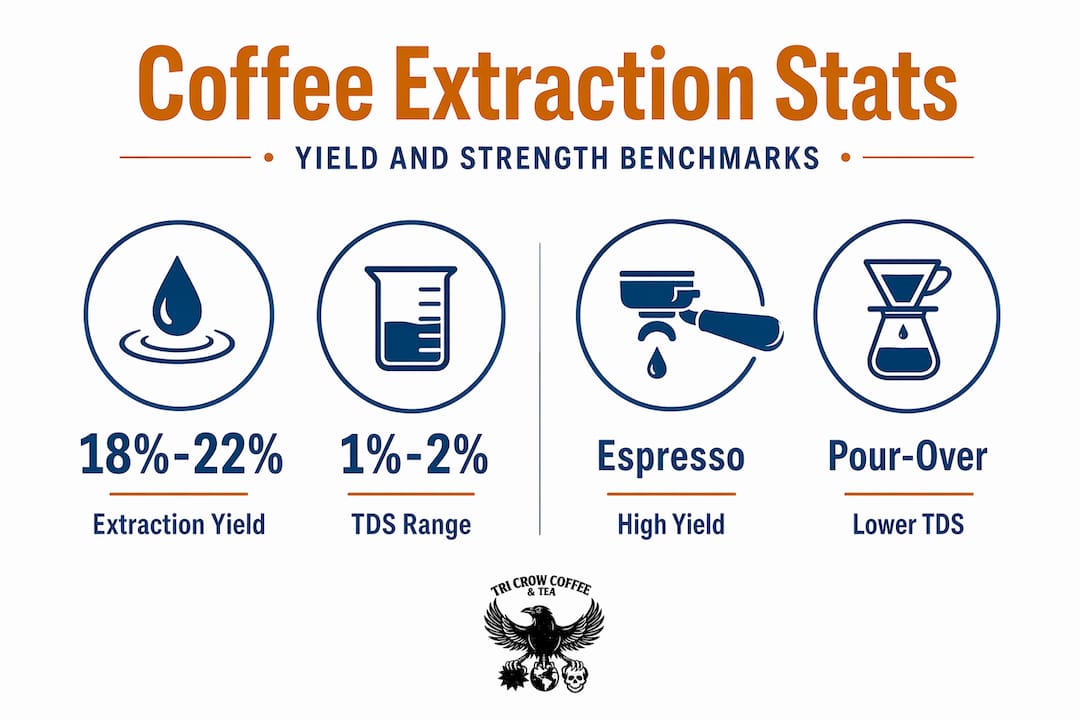
The measurable standard for this is extraction yield (EY), which tells you what percentage of the dry coffee mass actually ended up dissolved in your brew. According to SCA standards, the accepted sweet spot sits between 18% and 22% for a balanced, flavorful cup. Below 18%, you are under-extracting. Above 22%, you are over-extracting.
Here is what those ranges actually taste like:
-
Under-extracted (below 18%): Sour, sharp, and thin. Acids dissolve first during brewing, so a brew that ends too early tastes bright in the wrong way, lacking sweetness or body.
-
Balanced extraction (18% to 22%): Sweetness, acidity, and bitterness exist in harmony. This is the range where a coffee’s intended flavor profile comes through with clarity.
-
Over-extracted (above 22%): Bitter, dry, and astringent. The compounds that dissolve last during brewing are the harsh ones, and pushing past the ideal window pulls them into your cup.
It is also worth separating extraction yield from strength, often measured as Total Dissolved Solids (TDS). Strength refers to how concentrated your brew is. A strong cup could be under-extracted if you used a lot of coffee but didn’t brew it long enough. A balanced extraction at low concentration produces a light but well-structured cup. These two parameters move independently, which is why tuning one does not automatically fix the other.
With this foundational understanding of what extraction means, let’s explore how various brewing variables influence extraction and flavor.
How brewing variables affect extraction and flavor balance
Every brewing decision you make either speeds up or slows down extraction. Understanding these levers gives you real control over the outcome in your cup.
Grind size is probably the most influential variable. Finer grinds create more surface area, which accelerates extraction. Coarser grinds slow it down. Grinding too fine risks over-extraction; too coarse risks under-extraction. This is why a slight grind adjustment is usually the first fix when something tastes off.

Water temperature works on a similar principle. Hotter water dissolves compounds faster. The practical range for most brewing is 90°C to 96°C (194°F to 205°F). Cold brew is a fascinating outlier because it uses extended time, typically 12 to 24 hours, to compensate for low temperature.
Key variables and their effects at a glance:
-
Grind size: Finer increases extraction speed; coarser slows it down
-
Water temperature: Higher temperatures accelerate dissolution of solubles
-
Contact time: Longer contact pulls more compounds, increasing EY
-
Pressure: Critical in espresso; 9 bars of pressure forces extraction in 25 to 35 seconds
-
Coffee bed evenness: Uneven distribution causes channeling, where water bypasses part of the grounds and over-extracts other areas
-
Coffee-to-water ratio: More coffee per unit of water increases concentration but does not directly increase EY
Espresso is the method where all of these variables interact most intensely. As espresso extraction science shows, pressure, temperature, time, and grind size must all be calibrated together to produce repeatable, predictable flavor. Changing one without adjusting the others often creates a new problem. Understanding coffee crema is actually one of the fastest visual feedback tools for reading whether your espresso extraction is heading in the right direction.
Pro Tip: Before grinding your beans, lightly spritz them with a small amount of water using a spray bottle. This reduces static buildup, which causes fine particles to clump and distribute unevenly in the portafilter or brewer. Fewer clumps means more even extraction and a noticeably cleaner cup.
Now that you know which variables affect extraction, let’s look at how to measure and interpret the results.
Measuring extraction yield and strength: tools and interpretation
You can taste your way to better coffee, and you absolutely should. But having numbers to anchor your observations changes everything. Two measurements define your brew’s behavior.
TDS (Total Dissolved Solids) measures the concentration of dissolved coffee in your final cup, expressed as a percentage. A typical drip coffee sits around 1.2% to 1.5% TDS. Espresso runs much higher, typically 8% to 12%.
Extraction yield (EY) is calculated from TDS using the formula: EY = (TDS × beverage weight) / dry coffee dose. A refractometer gives you TDS, and from there, EY is a short calculation.
| Brew method | Typical TDS range | Typical EY range |
|---|---|---|
| Espresso | 8% to 12% | 18% to 22% |
| Pour-over | 1.2% to 1.5% | 18% to 22% |
| French press | 1.0% to 1.4% | 18% to 22% |
| Drip coffee | 1.2% to 1.5% | 18% to 22% |
| Cold brew concentrate | 3% to 6% | 15% to 20% |
The SCA Brewing Control Chart maps TDS against EY to show a visual “ideal zone.” Brews that fall outside this zone, whether too weak, too strong, under-extracted, or over-extracted, produce identifiable flavor defects that you can now diagnose by the numbers rather than guessing.
Practical signs of measurement-backed diagnosis:
-
High TDS, low EY: Strong but sour. You used a lot of coffee but didn’t extract it properly. Grind finer or brew longer.
-
Low TDS, high EY: Watery but bitter. Good extraction of a small dose. Increase your coffee-to-water ratio.
-
Low TDS, low EY: Thin and sour. Under-extracted overall. Fix grind, temperature, or time.
Pairing measurement tools with sensory skills like cupping builds the kind of calibrated palate that lets you diagnose a brew the moment it hits your tongue.
Understanding how to measure and interpret these values enables you to refine your brewing process effectively.
Extraction differences among popular brewing methods
Not all brewing methods extract the same way. The mechanics are fundamentally different, and those differences create the distinct personalities each method is known for.
| Method | Extraction mechanism | Typical brew time | TDS range | Flavor character |
|---|---|---|---|---|
| Espresso | Pressure-forced percolation | 25 to 35 seconds | 8% to 12% | Intense, syrupy, concentrated |
| Pour-over | Gravity percolation | 3 to 4 minutes | 1.2% to 1.5% | Clean, layered, complex |
| French press | Full immersion | 4 minutes | 1.0% to 1.4% | Full-bodied, textured, rich |
| Drip | Automated percolation | 5 to 8 minutes | 1.2% to 1.5% | Consistent, accessible, balanced |
| Cold brew | Cold immersion | 12 to 24 hours | 1.5% to 6% (varies) | Smooth, low-acid, round |
As research into brewing methods confirms, espresso uses fine grind and pressure for fast, high-TDS extraction, while pour-over and French press rely on slower percolation or immersion for a different set of solubles and textures. Exploring the range of coffee brewing approaches also reveals how blend composition and roast level interact with each method’s extraction profile.
Key takeaways for home brewers across methods:
-
Espresso rewards precision; small changes have outsized effects
-
Pour-over is highly responsive to grind size and pour technique
-
French press is forgiving but favors consistent steep time and coarse grind
-
Cold brew is the lowest-risk method for beginners because time compensates for imprecision
Pro Tip: In pour-over brewing at home, chase consistency before chasing ideal EY numbers. If your technique changes every brew, your numbers are meaningless. Lock in your grind, ratio, and pour pattern first, then adjust one variable at a time.
With a clear view of how brewing methods differ, let’s explore what the science says about extracting even more consistently.
Scientific insights and advanced techniques for consistent extraction
Coffee extraction science has moved far beyond kitchen wisdom. Researchers are now analyzing individual molecules as they dissolve during brewing, which gives us genuinely new tools for improving consistency.
Electrochemistry research from the SCA validated what some baristas suspected and others dismissed: spritzing beans before grinding does measurably improve extraction consistency by reducing static-induced clumping. This is not a TikTok trick. It is science-backed technique.
Key findings from recent extraction research:
-
Temperature and pressure interact non-linearly in espresso; small temperature changes at constant pressure shift flavor dramatically
-
Grind size distribution matters as much as average particle size; a burr grinder with consistent particle sizing outperforms a blade grinder at any setting
-
Water chemistry, specifically mineral content, directly affects which compounds dissolve and how efficiently; filtered water with moderate mineral content (around 150 ppm total hardness) is widely considered optimal
-
The sequence of solubles extraction is predictable: acids first, then sugars and balanced compounds, then bitter materials last
“Moving from guesswork to measurable control is the real shift for home brewers. Once you understand the chemistry of what you’re tasting, every adjustment becomes intentional.” — Specialty Coffee Association Research Team
These insights give us new tools to master extraction. Let’s now reflect on what they mean for your brewing practice specifically.
Rethinking coffee extraction: beyond traditional rules
Here is the thing nobody tells you when you first encounter the 18% to 22% extraction yield target: it is a useful benchmark, not a universal law. The Specialty Coffee Association developed it as a consensus starting point. It was never meant to apply identically to every coffee on earth.
A naturally processed Ethiopian bean extracted at 22% will taste completely different from a washed Colombian extracted at the same number. Roast level changes what’s soluble. Processing method changes compound composition. Origin changes the acid and sugar profile. The number alone does not define quality. Your palate does.
The real skill in understanding coffee extraction is learning to use measurement as a check on your senses, not a replacement for them. A refractometer tells you where you are. It does not tell you where you should be for this specific coffee on this specific morning. That judgment belongs to you.
We encourage brewing with a kind of ritual attention, the same intentional awareness that goes into every batch we roast. Tasting critically, adjusting deliberately, and understanding where your coffee comes from sharpens your ability to sense what a coffee wants to be.
Pro Tip: Keep a simple brewing log. Note your dose, grind setting, water temperature, brew time, and a few honest tasting words after each session. Within a week, patterns emerge. Within a month, you stop guessing.
Experimentation is not failure. It is the method. Every brewer who consistently produces an outstanding cup got there by treating each brew as data.
Enhance your brewing with Tri Crow Coffee’s premium beans and blends
Extraction knowledge without quality beans is a calculation with a weak input. Now that you understand the variables, you need coffee that rewards the attention you’re giving it.
At Tri Crow Coffee, every small-batch roast is designed with extraction in mind. Our Mint Coffee coarse grind is specifically suited to immersion methods like French press, where contact time and grind consistency matter most. If you favor intense, bold profiles that hold up under espresso pressure, our French Roast delivers a full-extraction character with depth and body. And if you want to practice adjusting your extraction across wildly different flavor profiles, our single origin sample pack gives you a range of origins to experiment with side by side. Each one responds differently to grind, temperature, and time, which makes it one of the most educational things you can brew.
Frequently asked questions
What is the difference between coffee strength and extraction yield?
Strength, measured as TDS, tells you how concentrated your brewed coffee is, while extraction yield measures what percentage of soluble material you actually dissolved from the grounds. A brew can be strong and under-extracted, or weak and perfectly extracted, depending on your dose and brewing parameters.
Why is under-extracted coffee sour and over-extracted coffee bitter?
Compounds dissolve in a predictable sequence during brewing. Acids extract first, producing sourness when brewing ends too early. Bitter compounds like chlorogenic acid breakdown products dissolve last, creating harshness when you push extraction too far.
How can I improve consistency in my coffee extraction at home?
Stable water temperature, a consistent grind, and spritzing beans before grinding are three evidence-backed techniques that meaningfully improve repeatability. Keeping a brewing log to track variables and tasting notes also accelerates your ability to diagnose and correct problems.
Is it necessary to use a refractometer to brew good coffee at home?
No. A refractometer is helpful for precise measurement, but most skilled home brewers improve simply by tasting carefully, adjusting one variable at a time, and building consistent habits. The tools support your senses; they do not replace them.
Recommended
-
Discover Coffee Bean Types, Flavor Profiles, and Origins – Tri Crow Coffee
-
How to select coffee beans for great home brewing flavor – Tri Crow Coffee
-
Why coffee processing matters: flavor, ethics, and sustainability – Tri Crow Coffee
-
Whole bean coffee: unlock flavor, freshness, and ritual – Tri Crow Coffee