
TL;DR:
- Coffee degassing is the process by which carbon dioxide is gradually released from freshly roasted beans, influencing brewing and flavor. The timing of degassing varies with roast level, typically taking 7 to 21 days, and significantly affects extraction, bloom behavior, and taste quality. Proper packaging and tracking roast dates help optimize brewing by aligning with the ideal degassing window for the beans.
Coffee degassing is the gradual release of carbon dioxide (CO2) trapped inside freshly roasted beans, and it directly controls how your coffee brews and tastes. Every roasted bean holds pressurized gas produced during the roasting process. That gas escapes slowly over days and weeks, changing the bean’s chemistry and brewing behavior at every stage. Understanding the coffee degassing process tells you exactly when to brew, how to adjust your technique, and why a bag of beans roasted yesterday will taste completely different from one roasted two weeks ago.
What is coffee degassing and what causes it?
Coffee degassing is defined as the post-roast outgassing of CO2 from the cellular structure of roasted coffee beans. The gas originates during roasting, when heat triggers the Maillard reaction and Strecker degradation. Both reactions break down amino acids and sugars, producing large volumes of CO2 that become trapped inside the bean’s porous cell walls.
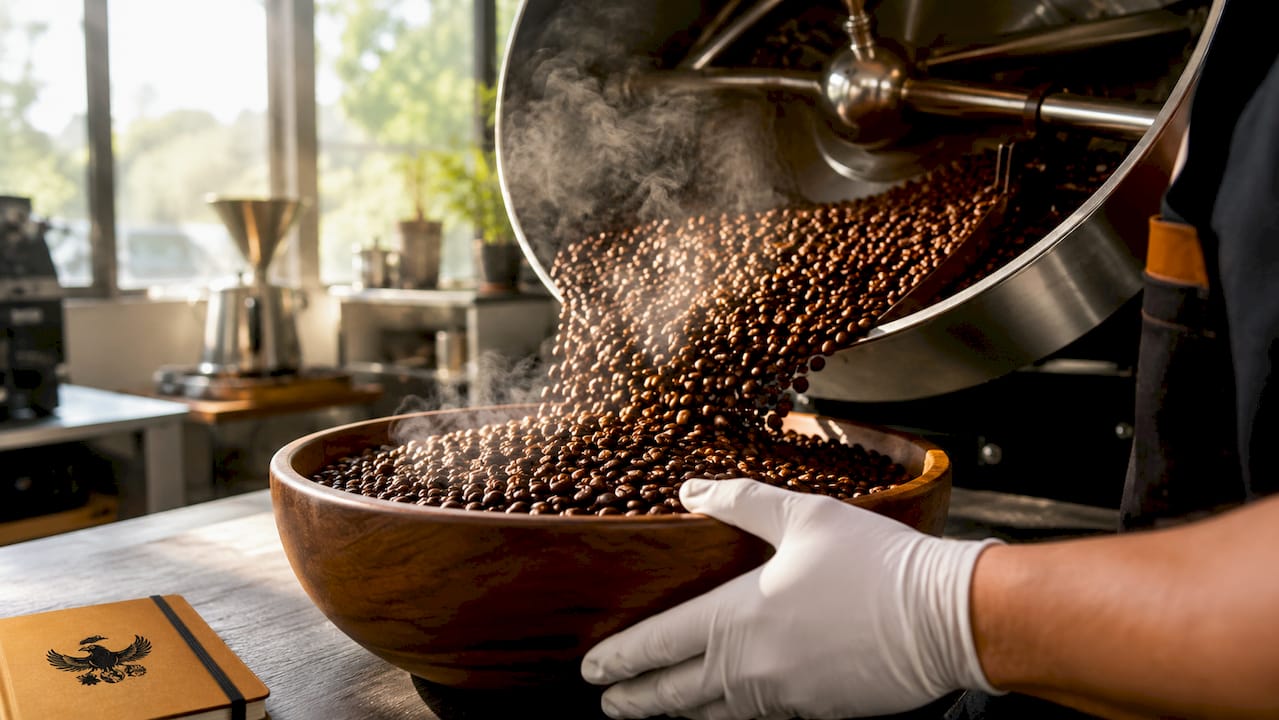
The amount of CO2 produced is significant. A single gram of roasted coffee can hold several milliliters of gas under pressure. Once roasting ends and beans begin to cool, that pressure has nowhere to go except outward through the cell walls. The release starts immediately and continues for days to weeks depending on roast level, grind state, and storage conditions.
Why does this matter for brewing? Excess CO2 repels water, preventing even saturation of the grounds. The result is uneven extraction, which produces sour, metallic, or hollow flavors in the cup. Proper degassing allows water to penetrate the grounds evenly, releasing aromatic compounds in a balanced sequence.
Key causes of CO2 buildup during roasting:
- Maillard reactions between amino acids and reducing sugars
- Strecker degradation releasing CO2 as a byproduct
- Caramelization of sugars at high temperatures
- Physical expansion of the bean’s cellular structure during second crack
Pro Tip: If your coffee tastes sharp or metallic with no clear sweetness, the beans may be too fresh. Give them two to three more days of rest before brewing again.
How long does the coffee degassing process take?
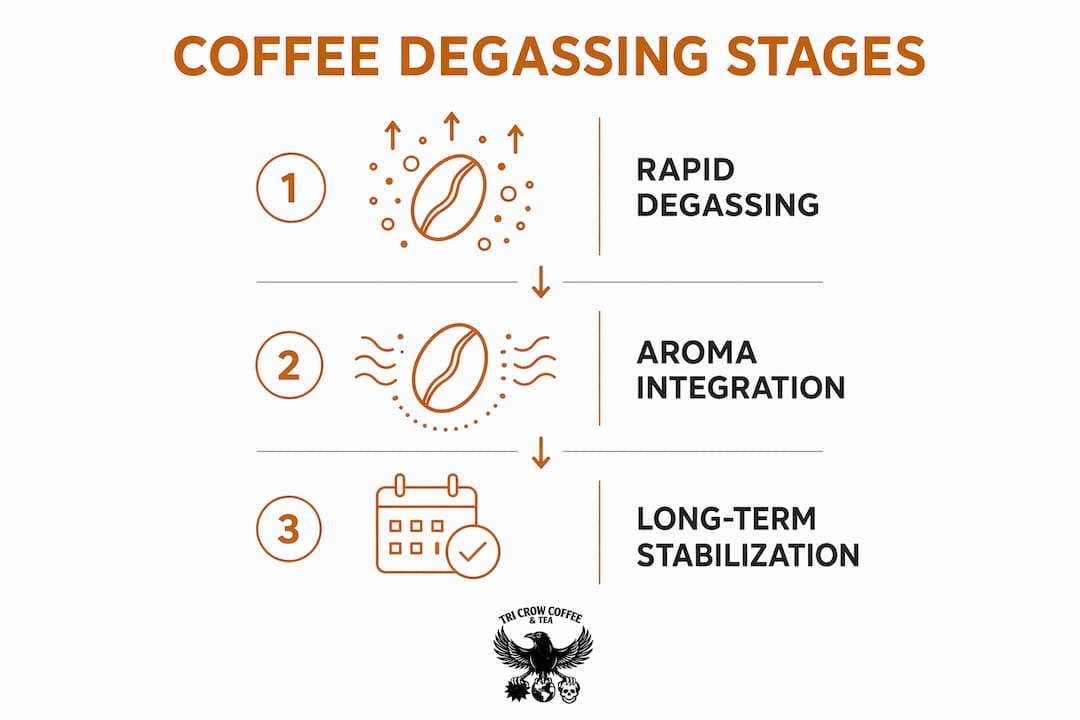
The degassing timeline unfolds in three distinct phases, and each phase produces a different brewing experience. Knowing where your beans sit in this timeline is the single most useful piece of information you can have before you brew.
Stage 1: Rapid degassing (hours 0–48 post-roast)
The first 48 hours after roasting see the most aggressive CO2 release. Beans are highly unstable during this window. Brewing at this stage produces a chaotic bloom, uneven extraction, and flavor that reads as bright but unbalanced. Most coffees taste best between 7 and 21 days after roasting, which means Stage 1 beans are almost never at their peak.
Stage 2: Slow degassing and aroma integration (days 2–7)
CO2 release slows significantly after the first 48 hours. This is the phase where volatile aromatic compounds begin to stabilize inside the bean. Flavor complexity builds during this window, and most medium roasts start to become genuinely enjoyable around day 4 or 5.
Stage 3: Long-term stabilization (days 7–21)
Gas levels drop to a point where water can saturate the grounds evenly. This is the sweet spot for most brewing methods. After day 21, oxidation begins to outpace any remaining degassing benefit, and freshness declines.
Roast level changes this timeline significantly. Darker roasts degas faster because the roasting process produces more CO2 and creates a more porous bean structure after second crack. Lighter roasts retain CO2 longer because the cell walls remain denser.
| Roast level | Expected degassing duration | Best brew window |
|---|---|---|
| Dark roast | 3–7 days | Days 3–10 post-roast |
| Medium roast | 5–10 days | Days 5–14 post-roast |
| Light roast | 7–14 days | Days 7–21 post-roast |
| Espresso grind (any roast) | Faster by 1–2 days | Adjust window earlier |
Pro Tip: Write the roast date on your bag with a marker the day it arrives. Tracking the exact age of your beans removes all guesswork from your brew adjustments.
What are the practical effects of degassing on brewing?
Degassing is not just a background chemical process. It changes specific brewing variables in ways you can measure and adjust. The four areas most affected are bloom time, water temperature, grind size, and espresso extraction.
Bloom time adjustments
The bloom is the 30–45 second pre-infusion step where hot water saturates the grounds before full brewing begins. Fresh beans produce a dramatic, domed bloom because CO2 is escaping rapidly and pushing water away. Younger beans require bloom times of 45–60 seconds to allow enough gas to escape before full extraction begins. Rested beans at peak degassing need only about 30 seconds. Skipping or shortening the bloom on fresh beans causes channeling and uneven flavor.
Water temperature and grind size
Higher water temperature helps overcome gas resistance in very fresh beans. Brewing at 205°F instead of 200°F gives water more energy to push through CO2 pressure. As beans age and degas further, you can lower temperature slightly to preserve delicate aromatics. Grind size also interacts with degassing: finer grinds on fresh beans increase surface area and accelerate gas release during brewing, which can cause over-extraction. A slightly coarser grind on very fresh beans gives CO2 more room to escape without disrupting extraction flow.
Espresso and CO2 channeling
Espresso is the brewing method most sensitive to degassing. Excess CO2 causes channeling by creating uneven resistance in the puck, which forces water through weak spots rather than through the entire dose. The result is a shot that pulls too fast, tastes sour, and lacks body. Interestingly, excessive CO2 increases crema volume but masks the true flavor profile underneath. More crema does not mean better espresso. It often means the beans needed more rest.
Practical brewing adjustments by bean age:
- Days 1–3: Avoid brewing if possible. If you must brew, use a 60-second bloom, coarser grind, and higher water temperature (205°F).
- Days 4–7: Extend bloom to 45 seconds. Adjust grind slightly finer than your baseline. Expect bright, lively flavors.
- Days 7–14: Use your standard bloom time of 30 seconds. This is the optimal window for most pour-over and drip methods.
- Days 14–21: Tighten your grind slightly to compensate for reduced CO2 resistance. Flavors will be fuller and rounder.
- Days 21 and beyond: Brew promptly. Oxidation is now the primary concern. Store beans in an airtight container away from light.
Pro Tip: For better coffee extraction, treat your bloom as a diagnostic tool. A weak or flat bloom tells you the beans are past their peak window.
How does degassing interact with coffee packaging and storage?
Packaging is where the coffee degassing process meets real-world logistics. Roasters ship beans within days of roasting, which means the bag you receive is still actively releasing CO2. Without the right packaging, that gas has nowhere to go and creates serious problems.
One-way degassing valves allow CO2 to exit the bag while blocking oxygen from entering. This solves two problems at once. The bag does not rupture from internal pressure, and the beans do not oxidize prematurely. Without these valves, roasters would need to wait days before sealing bags, which would expose beans to oxygen during the most critical freshness window.
What to look for in coffee packaging and storage:
- A one-way valve on the bag (a small circular button, usually on the front or back)
- Opaque or foil-lined material to block light exposure
- A resealable zipper or fold-lock closure to minimize air contact after opening
- A printed roast date, not a “best by” date, so you can calculate your brew window accurately
Home storage matters just as much as the original packaging. Keeping beans in their original bag, sealed tightly, at room temperature away from heat and light, preserves the degassing process without accelerating oxidation. Refrigerating whole beans is not recommended because condensation introduces moisture that disrupts both degassing and flavor. A dedicated airtight canister with a CO2 valve works well for beans you plan to use over two weeks.
The packaging material itself affects degassing speed. Thinner bags allow faster gas exchange with the environment, which can accelerate degassing beyond the optimal rate. Quality roasters like Tri Crow Coffee use multi-layer foil bags with one-way valves precisely to control this rate and deliver beans at the right stage of degassing for your brew window.
How to degas coffee properly at home
Managing degassing at home comes down to observation, timing, and small adjustments. You do not need special equipment. You need to pay attention to what your beans are telling you.
-
Check the roast date immediately. The roast date is your most important data point. Calculate your target brew window based on roast level using the table above. Mark the date on your calendar or bag.
-
Watch your bloom. A strong, domed bloom signals fresh beans still releasing CO2 actively. A flat or weak bloom signals beans past their peak. Experienced baristas use bloom behavior as a freshness diagnostic at every brew session.
-
Adjust bloom time by bean age. Fresh beans (days 2–5) need a 45–60 second bloom. Beans in the optimal window (days 7–14) need about 30 seconds. Do not use a fixed bloom time regardless of bean age.
-
Grind only what you need. Ground coffee degasses up to 10 times faster than whole beans because grinding dramatically increases surface area. Grinding immediately before brewing preserves CO2 at the level appropriate for your bean’s current age. Pre-grinding days in advance collapses the degassing curve and flattens flavor.
-
Store whole beans in a sealed, opaque container. Avoid clear glass jars on the counter. Light and heat both accelerate degassing beyond the natural rate, which shortens your optimal brew window.
-
Track your adjustments. Keep a simple log of roast date, brew date, bloom time, and flavor notes. After three or four sessions with the same bag, you will see a clear pattern that tells you exactly when that specific roast hits its peak for your palate. You can also explore selecting beans by roast level to match your preferred degassing window from the start.
The internal bean pressure created by CO2 directly modulates extraction speed and flavor balance. High CO2 biases extraction toward early-leaching compounds, producing brightness but less sweetness and body. Proper rest brings these elements into balance. Degassing is not just gas loss. It is an extraction modulator that shapes every sensory quality in your cup.
Key takeaways
Coffee degassing is the CO2 release process that controls extraction balance, bloom behavior, and flavor development from roast to cup.
| Point | Details |
|---|---|
| Degassing starts at roast | CO2 release begins immediately after roasting and continues for up to three weeks. |
| Optimal brew window | Most coffees taste best between 7 and 21 days post-roast as aromas integrate. |
| Roast level changes timing | Dark roasts rest 3–7 days; light roasts need 7–14 days before peak flavor. |
| Bloom reveals freshness | A strong bloom means active CO2; a flat bloom signals the peak window has passed. |
| Packaging protects the process | One-way valve bags control CO2 release and block oxygen to preserve freshness. |
Why I stopped ignoring roast dates
I used to treat a fresh bag of coffee like a gift to open immediately. The beans smelled incredible, the bloom was dramatic, and I assumed that meant I was getting the best possible cup. I was wrong every time.
The first time I deliberately rested a bag for 10 days before brewing, the difference was not subtle. The same beans that tasted sharp and hollow on day two produced a round, sweet, fully developed cup on day 10. That experience changed how I think about freshness entirely. Fresh does not mean ready. It means the process has started.
The mistake most home brewers make is treating the roast date as a countdown to staleness rather than a countdown to peak flavor. The window between “too fresh” and “past peak” is real, and it is worth protecting. That means tracking dates, adjusting your bloom, and resisting the urge to grind the whole bag at once.
The CO2 in your beans is not a problem to solve. It is a signal to read. A big, active bloom tells you the beans need more time. A quiet, flat bloom tells you to brew today. Once you start reading those signals, every cup gets better.
— David
Brew better with Tri Crow Coffee’s small-batch roasts
Understanding degassing only pays off when you start with beans roasted to a precise, trackable standard. Tri Crow Coffee roasts in small batches with every bag stamped with a roast date, so you always know exactly where your beans sit in their degassing window. Each bag ships with a one-way valve to protect CO2 release and block oxidation during transit.
If you want a blend that rewards the wait, the Max Caf Blend is a strong starting point for home brewers who want to experience the full degassing arc from roast to peak cup. For those who prefer a darker profile with a shorter rest window, the French Roast hits its stride in just three to five days. Browse the full selection at Tri Crow Coffee and brew with intention.
FAQ
What is coffee degassing in simple terms?
Coffee degassing is the release of carbon dioxide gas from roasted coffee beans after roasting. The gas builds up during roasting and escapes gradually over days to weeks, affecting how the coffee brews and tastes.
Why is coffee degassing important for flavor?
Excess CO2 in fresh beans repels water during brewing, causing uneven extraction and sour or metallic flavors. Allowing beans to degas to the right level produces balanced, sweet, and fully developed flavor in the cup.
How long should you wait before brewing fresh coffee?
Most coffees taste best between 7 and 21 days after roasting. Dark roasts are ready in 3–7 days, while light roasts benefit from 7–14 days of rest before brewing.
Does grinding coffee speed up degassing?
Yes. Ground coffee degasses significantly faster than whole beans because grinding increases surface area and accelerates CO2 release. Grind only what you need immediately before brewing to preserve the optimal degassing stage.
What does a good bloom tell you about degassing?
A strong, domed bloom during brewing indicates the beans are still actively releasing CO2 and are likely within their fresh window. A weak or absent bloom signals the beans have fully degassed and may be past their peak freshness.