
Most coffee drinkers assume a sealed bag of beans stays good for months. The reality is sharper and more unforgiving. What is coffee freshness, exactly? It’s the measure of how much aromatic, flavorful, and chemical vitality remains in your coffee from the moment it was roasted. That vitality fades fast, especially after opening, and especially after grinding. Understanding this single concept changes how you buy, store, and brew. Everything that makes coffee worth drinking depends on it.
Table of Contents
- Key takeaways
- What coffee freshness actually means
- What affects coffee freshness
- Storage methods and packaging that preserve freshness
- How to determine coffee freshness and use it well
- What freshness has taught me about brewing
- Experience freshness in every cup with Tri Crow Coffee
- FAQ
Key takeaways
| Point | Details |
|---|---|
| Freshness is chemical, not just a date | Coffee freshness reflects the presence of volatile oils and CO2, not just how recently it was roasted. |
| Grinding accelerates flavor loss | Ground coffee loses aromatic compounds within hours; whole beans stay fresh significantly longer. |
| Four enemies degrade freshness | Oxygen, moisture, heat, and light all strip flavor and aroma from coffee beans. |
| Packaging technology matters | Nitrogen-flush packaging can extend shelf life from 3-4 months to 6-9 months without sacrificing quality. |
| Buy small, use fast | Purchasing in smaller batches and using coffee within days of opening is the most reliable freshness strategy. |
What coffee freshness actually means
Coffee freshness is not simply a roast date stamped on a bag. It refers to the living, chemical state of roasted coffee beans at any given moment. After roasting, beans are loaded with volatile aromatic compounds, natural oils, and dissolved carbon dioxide. These elements are what produce the complex scents and layered flavors you taste in a great cup. As time passes and the beans interact with their environment, those compounds escape or degrade.
The CO2 inside freshly roasted beans plays a fascinating role. It acts as a natural preservative, slowly pushing out over hours and days in a process called degassing. This is why quality roasters rest their beans for 24 to 72 hours before selling them. Too much CO2 still inside the bean can actually interfere with proper extraction during brewing, creating a sour, uneven result. A one-way valve on packaging lets CO2 escape without letting oxygen in.
Here is what happens on a chemical timeline:
- Within hours of grinding: Aromatic compounds begin escaping immediately. Coffee aroma begins escaping the moment beans are ground, which is why grinding just before brewing makes such a measurable difference.
- Within days of opening whole beans: Volatile oils and aromatics drop rapidly once beans are exposed to oxygen.
- Within 1 to 3 weeks at room temperature: Most roasted beans reach peak freshness for about 1 to 3 weeks if left unopened at room temperature.
The sensory experience reflects this chemistry directly. Fresh coffee blooms when hot water hits it. That dome of bubbling foam you see when brewing pour-over or French press is residual CO2 escaping from freshly roasted grounds. Stale coffee lies flat. No bloom, no complexity, no depth.
Pro Tip: If your coffee doesn’t bloom during brewing, that’s one of the clearest signs of fresh coffee you can observe. No bloom is one of the most reliable signs it’s past its best.
What affects coffee freshness
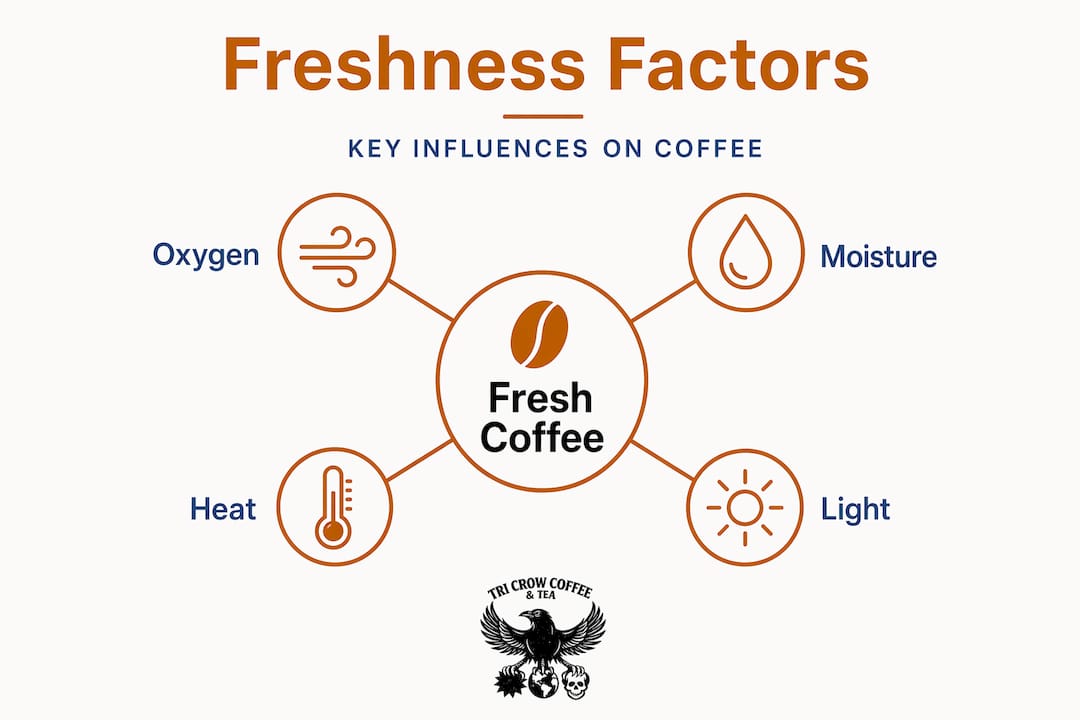
Four specific forces work against your beans the moment the roasting drum stops. Understanding each one helps you recognize why coffee freshness guidelines are built around minimizing exposure.
Oxygen, moisture, heat, and light are the four primary freshness enemies, and they don’t operate independently. They compound each other.
Oxygen is the most immediate threat. The moment beans hit open air, oxidation begins stripping away the complex flavor compounds that distinguish a well-sourced, well-roasted coffee from a flat one. This process is similar to what happens to a cut apple or a sliced avocado. The surface degrades first, and the damage moves inward.
Moisture is sneaky. It pulls soluble flavor compounds out of the bean prematurely, essentially pre-extracting your coffee before you ever grind it. High humidity environments accelerate staling significantly, which is why coffee kept near a stove or sink deteriorates faster than coffee stored in a cool pantry.
Heat speeds up the molecular breakdown of natural oils. Coffee oils are responsible for much of the mouthfeel and body in your cup. Once those oils oxidize or evaporate due to heat exposure, the resulting brew feels thin and tastes flat or rancid. Storing beans in a cabinet above the oven is one of the most common mistakes people make.
Light is particularly destructive for UV-sensitive aromatic compounds. This is why quality coffee packaging is almost always opaque. Clear glass jars look beautiful on a counter, but they expose beans to light degradation every hour of the day.
The interaction between these four factors explains why beans lose key aroma and flavor compounds so quickly after exposure. A bag left open on a sunny counter near the stove isn’t just slightly less fresh. It can be noticeably flat within 48 hours.
Storage methods and packaging that preserve freshness
Knowing what degrades freshness makes the storage conversation much more concrete. Not all packaging is equal, and not all home storage advice actually holds up under scrutiny.
Packaging technology: what actually works
| Packaging Type | Shelf Life | Best For |
|---|---|---|
| Standard sealed bag (no valve) | 1 to 2 weeks | Short-term retail display |
| One-way valve bag | 4 to 6 weeks | Freshly roasted specialty coffee |
| Vacuum-sealed packaging | 3 to 4 months | Medium-term shelf stability |
| Nitrogen-flush packaging | 6 to 9 months | Commercial shelf life extension |
Nitrogen-flushing extends shelf life from 3 to 4 months to 6 to 9 months by displacing oxygen inside the bag and allowing CO2 to escape while blocking air entry. It’s a significant technological step, though primarily used for commercial products aimed at shelf stability. For small-batch specialty coffee, the one-way valve bag remains the standard because it prioritizes peak flavor over maximum shelf duration.
Home storage best practices
Buying smaller batches, storing in airtight containers, and keeping beans in cool, dark places is the foundation. Beyond that, there are a few specifics worth knowing.
Airtight ceramic or metal containers work better than glass because they block light. Keep your storage container away from the oven, windowsills, and anywhere that experiences temperature fluctuations. The goal is a stable, cool, dark environment. A pantry shelf away from the stove is ideal.
The freezing question
Freezing is where most storage advice goes wrong. Freezing coffee at home risks moisture absorption and odor contamination unless the coffee is vacuum sealed and portioned for single use. The most damaging habit is pulling a bag out of the freezer repeatedly. Every time beans warm up and cool back down, condensation forms inside the bag. Moisture and repeated freeze-thaw cycles damage the bean structure and oils far more than simply storing beans properly at room temperature would.
If you do freeze coffee, portion it into vacuum-sealed bags before freezing and take out only what you’ll use that day. Never refreeze.
Pro Tip: Buy only what you’ll drink within two weeks. Buying in smaller quantities more frequently beats buying a large bag and hoping storage will compensate for the slow pace of use.
How to determine coffee freshness and use it well
Recognizing freshness before and after purchase takes practice, but the signals are consistent once you know what to look for.
Signs of fresh coffee
- The bloom test: Pour a small amount of hot water over your grounds and watch for a dome of foam. A strong, quick bloom indicates CO2 still present in freshly roasted coffee. Flat grounds are a clear sign of stale coffee.
- Aroma intensity: Fresh beans smell vivid, complex, and specific to their origin. Stale beans smell faint, papery, or like old cooking oil.
- Surface texture: Fresh whole beans often have a slight oily sheen, especially on darker roasts. Very dry, matte beans may have lost their oils to oxidation.
- The roast date: Always look for a roast date, not a “best by” date. A best-by date tells you almost nothing useful. A roast date lets you calculate exactly how fresh the coffee is.
Optimal freshness duration
- Whole bean coffee, unopened: 1 to 3 weeks at peak; usable up to a month if stored properly.
- Whole bean coffee, opened: Peak freshness lasts about one week once the bag is opened.
- Ground coffee, unopened: Freshness lasts 1 to 2 weeks unopened but declines quickly once exposed to air.
- Ground coffee, opened: Use within 24 hours for the best possible flavor.
The gap between whole bean and ground is dramatic. Grinding increases the surface area of the coffee by a factor of thousands, which accelerates every degradation process. If you want to know how to keep your beans fresh longer, grinding on demand is the single most effective habit to adopt.
Buying smarter
Portion your purchases around your actual consumption rate. If you brew one or two cups a day, a 12-ounce bag should last you about a week. That’s the window where your coffee is at its best. Avoid the temptation to buy in bulk to save money. The flavor loss isn’t worth the cost savings. For guidance on selecting beans that match your brewing style, knowing freshness timelines helps you decide between local roasters, online subscriptions, and what to prioritize at the store.
What freshness has taught me about brewing
I used to think I was doing everything right. Good beans, decent equipment, careful technique. Then I started paying attention to roast dates and tracking how my cups changed across the life of a bag. The difference between day three and day ten was not subtle. It was the kind of difference that made me rethink every assumption I had about what great coffee required.
The biggest mistake I see people make is treating coffee like a pantry staple with a long shelf life. It isn’t. It’s a perishable ingredient. Once you accept that, your whole purchasing and storage behavior shifts.
Freezing is the other piece that trips people up constantly. I’ve talked to plenty of enthusiasts who swear by it, and in almost every case they’re doing it without vacuum sealing or portioning. They’re pulling the same bag out of the freezer every morning, and they’re getting condensation damage on their beans every single time. The results in the cup are noticeably worse, and they’ve convinced themselves the freezer is helping.
What I’ve found actually works is simpler than most people expect. Buy less, more often. Grind just before brewing. Store in something airtight and opaque at room temperature. Find a roaster who labels roast dates clearly, because roast-date transparency is the clearest signal that a roaster actually cares about what you’re getting. Small-batch roasters tend to get this right because freshness is built into their model. The beans move faster, the lots are smaller, and the coffee in your cup reflects that.
— David
Experience freshness in every cup with Tri Crow Coffee
If this article has reshaped how you think about your daily brew, the next step is finding coffee that actually honors those standards.
Tri Crow Coffee roasts in small batches specifically to keep every bag as close to the roast date as possible when it reaches you. Each blend ships with clear roast-date labeling so you’re never guessing. Whether you prefer the cool brightness of the Mint Coffee coarse grind or the layered depth of the Coffee with Mushrooms Medium Roast, every product is crafted and packaged to deliver the flavor that freshness makes possible. For those looking to go deeper, the Tri Crow Coffee blog covers everything from storage rituals to brewing techniques. Fresh coffee isn’t just better tasting. It’s a different experience altogether.
FAQ
What is coffee freshness, and why does it matter?
Coffee freshness refers to how much of the original aromatic oils, volatile compounds, and CO2 remain in the beans after roasting. These elements directly determine flavor complexity and aroma quality in the cup.
How long does coffee stay fresh after roasting?
Whole bean coffee holds peak freshness for about 1 to 3 weeks unopened. Once opened, quality drops noticeably within one week, and ground coffee should be used within 24 hours for the best taste.
What are the main signs of fresh coffee?
Fresh coffee blooms actively when hot water hits the grounds, has a strong and distinct aroma, and may show a slight oily sheen on darker roasts. Stale coffee lies flat, smells faint or papery, and produces a thin, underwhelming brew.
Can you freeze coffee to keep it fresh?
Freezing is risky without vacuum-sealed, single-use portioning. Repeated freeze-thaw cycles cause condensation that damages bean structure and oils, often creating worse results than proper room-temperature storage would.
How can I tell if my coffee has gone stale?
Pour hot water slowly over your grounds during brewing. If there is no bloom and the aroma seems flat or off, the coffee has likely passed its freshness window. Checking the roast date before purchase is the most reliable preventive step.
Recommended
- Whole bean coffee: unlock flavor, freshness, and ritual – Tri Crow Coffee
- Why coffee processing matters: flavor, ethics, and sustainability – Tri Crow Coffee
- Why coffee origin matters: flavor, ethics, and sustainability – Tri Crow Coffee
- What is coffee blooming? A guide for coffee enthusiasts – Tri Crow Coffee