
TL;DR:
- Coffee grading involves evaluating green beans physically and through sensory cupping to determine quality and market value. Standards like the SCA threshold of 80 points help identify specialty coffee, but actual quality depends on combined physical and sensory data, which vary across regions. Proper interpretation of grading reports guides sourcing decisions, ensuring flavored, consistent, and fairly priced coffee.
Coffee grading is the systematic classification of green coffee based on physical characteristics and sensory evaluation to determine its quality and market value. Every bag of specialty coffee you buy has passed through this process before reaching a roaster. The Specialty Coffee Association (SCA) and country-specific systems like Kenya’s AA scale or Colombia’s Supremo classification each apply distinct criteria to sort, score, and price coffee lots. Understanding what is coffee grading, and how those grades translate to flavor and consistency, gives you a real advantage when sourcing or selecting coffee.
What is coffee grading and why does it matter?
Coffee grading is defined as the structured evaluation of green coffee using physical and sensory criteria to assign a quality classification before roasting. The process happens at two distinct stages. Physical grading occurs pre-roast and examines the raw bean. Sensory grading, or cupping, evaluates the brewed result.
The importance of coffee grading extends well beyond labeling. Grades directly influence pricing, roasting decisions, and flavor expectations. A coffee lot classified as specialty grade commands a market premium over commodity-grade coffee, and that premium reflects measurable differences in defect counts, bean uniformity, and cup scores. For buyers and enthusiasts alike, understanding coffee grades is the first step toward making sourcing decisions based on evidence rather than marketing language.
Grading also creates a shared language between producers, exporters, importers, and roasters. Without standardized evaluation, a “high-quality” claim from a farm in Ethiopia and one from a farm in Guatemala would be impossible to compare. Grading systems, even imperfect ones, provide that common reference point.
What physical criteria determine a coffee’s grade?
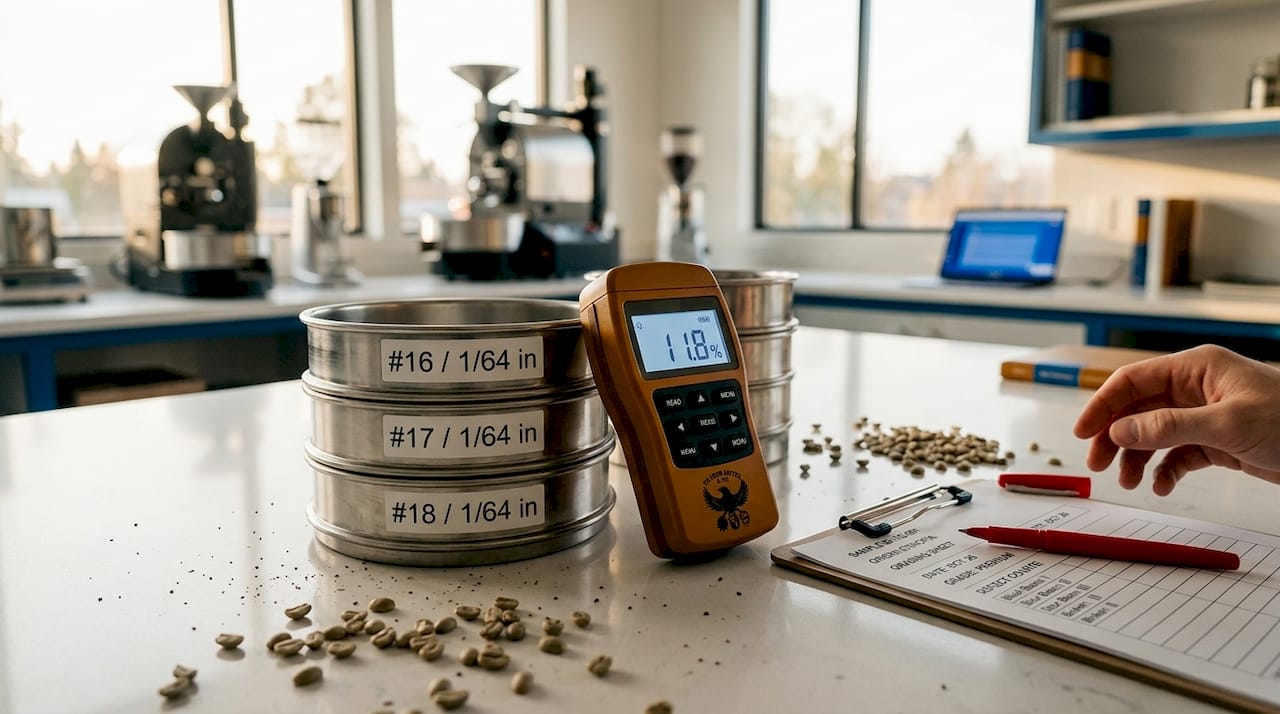
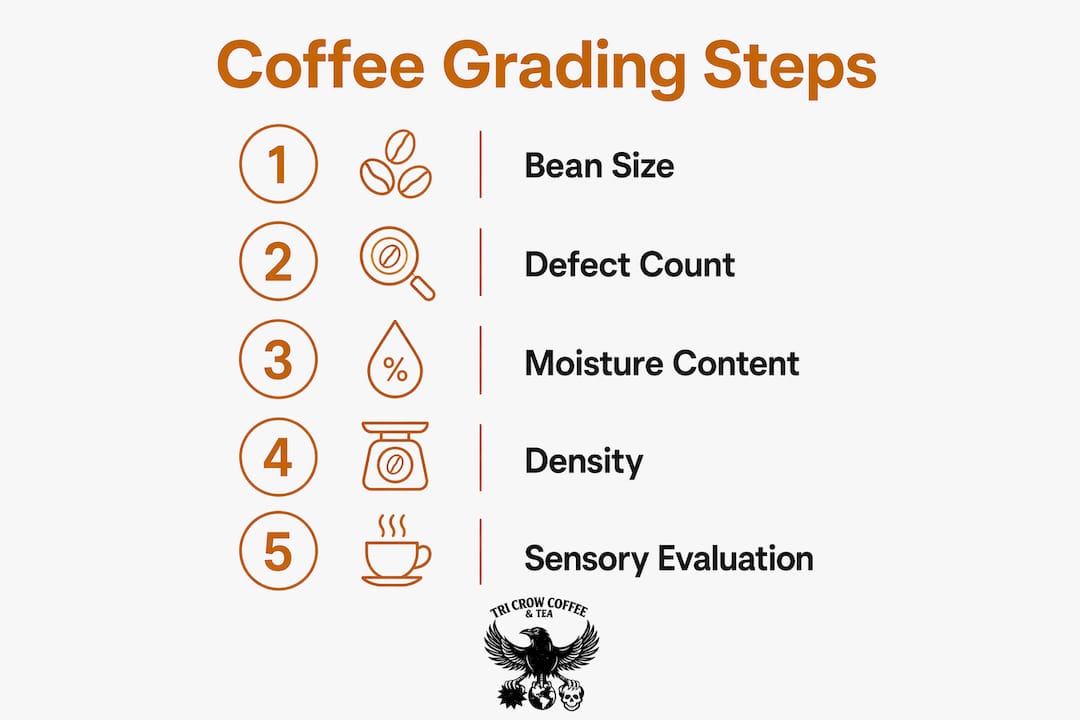
Physical grading covers four main factors: bean size, defect count, moisture content, and bean density. Each factor contributes to how the coffee will behave during roasting and what the final cup will taste like.
Bean size and screen sizing
Bean size is measured using metal sieves with aperture sizes calibrated in 1/64 inch increments. A screen 18 sieve has holes that are 18/64 of an inch wide. Beans that pass through a screen 18 but not a screen 14 are labeled as screen 14 to 18. This range tells a roaster that the beans are relatively uniform in size, which matters because uniformly sized beans roast more evenly. Uneven sizing causes some beans to over-roast while others under-roast in the same batch.
Defect counting
Defects are hand-counted in controlled 350-gram samples. Primary defects, such as full black beans or full sour beans, severely damage cup quality even in small numbers. Secondary defects, like partial blacks or insect damage, are less severe individually but accumulate quickly. Under SCA protocol, specialty-grade coffee allows zero primary defects and no more than five secondary defects in a 350-gram sample. Any lot exceeding those thresholds drops to premium or exchange grade, with a corresponding price reduction.
Moisture content and density
Moisture content affects shelf life and roast behavior. Coffee with moisture content outside the 10 to 12 percent range is more prone to mold, uneven roasting, or staling. Bean density, often tied to growing altitude, signals how hard and slow-developed the bean is. Denser beans absorb heat differently and generally tolerate longer roast profiles without burning.
Pro Tip: When reviewing a coffee lot’s grading report, check both the screen size range and the defect count together. A wide screen range with low defects is more useful than a narrow screen range with high defects.
How does sensory evaluation work in coffee quality assessment?
Physical grading tells you what the bean looks like. Sensory evaluation tells you what it tastes like. The SCA’s cupping protocol is the most widely recognized method for sensory coffee quality assessment, and it scores coffee on a 100-point scale.
The ten attributes scored in an SCA cupping session are:
- Fragrance and aroma — the smell of dry grounds and the wet crust after hot water is added
- Flavor — the overall taste impression, including sweetness, bitterness, and fruit notes
- Aftertaste — how long and pleasantly the flavor lingers after swallowing
- Acidity — the brightness or liveliness of the cup, not sourness
- Body — the weight and texture of the liquid on the palate
- Balance — how well the attributes complement each other without one dominating
- Sweetness — the presence of natural sugars, scored across five cups in a session
- Uniformity — consistency across the five cups evaluated in a session
- Clean cup — absence of off-flavors or defects in the brewed coffee
- Overall impression — the cupper’s holistic judgment of the lot
Coffee scoring 80 or above on this scale qualifies as specialty grade. That threshold is not arbitrary. It represents a cup that is free of defects, expressive in flavor, and consistent across multiple brews. Scores below 80 classify as premium, exchange, or below-standard grade, each with lower market value.
The SCA has also developed the Coffee Value Assessment (CVA), which uses a descriptive CATA methodology to reduce inconsistency among cuppers. CATA stands for Check All That Apply, and it asks evaluators to select from a standardized list of sensory descriptors rather than inventing their own language. This produces more consistent and communicable results across different labs and evaluators. For buyers, a CVA report gives a richer picture of a coffee’s character than a single number.
Pro Tip: Ask your supplier for both a numeric cupping score and a descriptive sensory report. The number tells you the grade; the descriptors tell you whether the flavor profile matches what you are looking for.
You can deepen your understanding of how sensory evaluation connects to the cup by exploring coffee cupping basics and what each attribute reveals about a coffee’s origin and processing.
How do coffee grading systems differ around the world?
Coffee quality classifications are system-specific, not universal. A grade from Kenya and a grade from Colombia use different criteria and cannot be directly compared without understanding the context of each system. This is one of the most common sources of confusion for buyers.
| Origin | Grade name | Primary criteria | What it signals |
|---|---|---|---|
| Kenya | AA | Bean size (screen 18+) | Large, uniform beans; not a flavor guarantee |
| Colombia | Supremo | Bean size (screen 17+) | Largest Colombian export grade by size |
| Central America | SHB (Strictly Hard Bean) | Growing altitude and density | Dense, high-grown beans with complex flavor potential |
| Ethiopia | Grade 1 | Defect count and cup quality | Lowest defect count; highest cup quality in Ethiopian system |
| Brazil | Fine Cup / Strictly Soft | Cup quality descriptors | Flavor-based classification common in Brazilian exports |
Kenya’s AA grade and Colombia’s Supremo are both considered top-tier in their respective systems, but they measure different things. Kenya AA is primarily a size classification. Colombia Supremo is also size-based. Neither grade guarantees a specific cupping score. Ethiopia’s Grade 1, by contrast, incorporates both defect limits and cup quality, making it more directly comparable to SCA specialty standards.
Altitude and density serve as grading markers in Central American systems. Strictly Hard Bean (SHB) coffee is grown above 1,200 meters, where cooler temperatures slow bean development and produce denser, more complex beans. Strictly Soft Bean (SSB) coffee grows at lower altitudes and typically produces a milder, less complex cup. The altitude grade is a proxy for density, and density is a proxy for flavor potential.
Some markets apply European Preparation standards, which impose tighter defect limits and stricter removal of undersized beans than standard preparation. This matters for buyers sourcing for premium European markets where cleanliness and uniformity expectations are higher.
The practical advice for buyers is straightforward: always ask what criteria a grade is based on before comparing lots from different origins. Understanding why coffee origin matters gives you the context to interpret those grades accurately.
What impact does grading have on flavor, consistency, and price?
Grading’s most direct practical effect is on roast consistency. When beans are uniform in size and density, a roaster can apply a single roast profile with predictable results. When a lot contains a wide range of sizes or high defect counts, some beans will roast too fast and others too slow, producing an uneven cup with both under-developed and over-roasted notes in the same batch.
The limitations of physical grading alone are real and worth understanding:
- Size does not predict flavor. A large screen size aids roast uniformity but does not guarantee a high cupping score if defects are present or if the growing conditions were poor.
- Defect counts do not capture everything. A lot can pass defect thresholds and still produce a flat, unremarkable cup if the variety, processing, or drying was suboptimal.
- Cupping scores shift with conditions. The same lot can score differently depending on roast level, water temperature, grind size, and the evaluator’s calibration. A score from one lab is not always directly comparable to a score from another.
- Specialty grade is a floor, not a ceiling. Scoring 80 qualifies a coffee as specialty, but the difference between an 80 and a 90 is enormous in terms of flavor complexity, sweetness, and clarity.
Pricing follows grading closely. Specialty-grade coffee (SCA score 80+) trades at a significant premium over commodity coffee, which is priced on the C market. Within specialty, each point above 80 typically adds value, with coffees scoring 85 and above commanding the highest premiums. For buyers sourcing directly from farms or importers, grading reports are the primary tool for justifying price negotiations. Knowing how to read a grading report, including both the physical evaluation and the cupping score, gives you the information you need to assess whether a price reflects actual quality.
Roast development also interacts with grading in ways that matter for flavor. A coffee’s origin characteristics, including the bean type and origin, shape how it responds to different roast levels, and grading data helps predict that behavior before the first roast.
Key takeaways
Coffee grading combines physical evaluation and sensory cupping scores to classify green coffee quality, and no single metric tells the full story without the other.
| Point | Details |
|---|---|
| Physical grading covers four factors | Bean size, defect count, moisture content, and density each affect roast behavior and cup quality. |
| SCA specialty threshold is 80 points | Coffee scoring 80 or above on the 100-point SCA scale qualifies as specialty and commands a market premium. |
| Country grades are not comparable | Kenya AA, Colombia Supremo, and Ethiopia Grade 1 each use different criteria and cannot be directly equated. |
| Size alone does not guarantee flavor | Screen size aids roast uniformity but does not predict cup quality if defect control is inadequate. |
| Descriptive sensory reports add context | CVA descriptive assessments communicate flavor character more precisely than a numeric score alone. |
Why I think most buyers misread coffee grades
I have spent enough time with grading reports to know that the most common mistake buyers make is treating a single number or grade label as a complete picture of quality. A Kenya AA with a cupping score of 79 is not a specialty coffee, regardless of how prestigious the AA designation sounds. Conversely, a Colombia Excelso, which is the smaller-bean grade below Supremo, can cup at 85 and outperform a lot of AA-labeled coffees from other origins.
The misconception runs deeper than just size grades. Many buyers assume that a higher cupping score automatically means a better experience in the cup for their specific use case. A coffee scoring 87 with intense citric acidity and a light body might be extraordinary as a pour-over and genuinely unpleasant as an espresso. Grading tells you what the coffee is. It does not tell you whether it is right for your palate or your brewing method.
What I have found actually works is treating grading data as a starting point, not a verdict. Request the full grading report, including defect counts, screen size range, moisture reading, and the cupping score with individual attribute breakdowns. Then ask whether the sensory profile matches your intended use. A supplier who cannot or will not provide that level of detail is a supplier worth reconsidering.
The other thing worth saying plainly: physical grading and sensory grading are both necessary, and neither is sufficient alone. A coffee with zero defects and a 78 cupping score is not specialty. A coffee with a 90 cupping score from a sample lot that does not represent the full shipment is not reliable. Both data points, evaluated together and in context, give you a grading picture you can actually use.
— David
Graded for quality, crafted for ritual
At Tri Crow Coffee, every coffee we source is evaluated against the same standards this article describes. Physical grading and sensory evaluation both inform which lots make it into our small-batch roasts. We do not source by label or reputation alone. We source by what the grading data and the cup actually tell us.
If you want to experience what specialty grading looks like in the cup, our single origin coffee beans collection is the place to start. Each offering is selected for transparency, traceability, and flavor integrity. These are coffees graded to specialty standards and roasted in limited batches to preserve what made them worth sourcing in the first place.
FAQ
What is coffee grading in simple terms?
Coffee grading is the process of evaluating green coffee beans using physical criteria like size and defect counts, and sensory criteria like cupping scores, to classify quality before roasting. It determines both the coffee’s market value and its expected flavor potential.
What does the SCA 80-point threshold mean?
Coffee that scores 80 or above on the SCA’s 100-point cupping scale is classified as specialty grade. This score reflects a cup that is free of defects, expressive in flavor, and consistent across multiple brewed samples.
Are coffee grades the same across all countries?
No. Country-specific grading systems like Kenya AA, Colombia Supremo, and Ethiopia Grade 1 each use different criteria, so grades from different origins are not directly comparable without understanding what each system measures.
Does a higher grade always mean better flavor?
Not necessarily. Physical grades measure size and defect counts, which affect roast consistency but do not guarantee flavor quality. A high screen size with poor cup quality is still not specialty coffee, and a cupping score must be paired with physical grading data for a complete picture.
How does coffee grading affect the price I pay?
Specialty-grade coffee (SCA score 80+) trades at a premium above commodity-grade coffee. Within specialty, higher cupping scores and lower defect counts typically command higher prices, making grading reports the primary tool for evaluating whether a price reflects actual quality.