
The right starting point is a coarse grind that looks and feels like sea salt or steel-cut oats, a 1:15 coffee-to-water ratio, and a 4-minute steep. That combination produces a full-bodied cup without the muddy, bitter sludge that sends most French press drinkers back to drip coffee. Everything else in this guide is just fine-tuning around that baseline.
Here’s the quick version before we get into the mechanics:
- Grind texture: coarse, resembling sea salt or steel-cut oats, never fine sand or powder
- Ratio by weight: 1:15 coffee to water (adjust to 1:13 for stronger, 1:17 for milder)
- Steep time: 4 minutes, then plunge and pour off immediately to stop extraction
If your cup tastes bitter or harsh, go coarser or cut the steep time slightly. If it tastes weak, sour, or flat, grind a touch finer or let it steep a bit longer. Small moves. One variable at a time.
Key Takeaways
A coarse grind, a 1:15 ratio, and a 4-minute steep form the foundation of consistent French press coffee, and taste-based adjustments refine everything from there.
| Point | Details |
|---|---|
| Start coarse, not fine | Aim for sea-salt or steel-cut-oats texture; fine grounds cause bitterness and sediment. |
| Weigh, don’t scoop | Use 1:15 as your baseline ratio, adjusting to 1:13 or 1:17 for strength. |
| Steep exactly 4 minutes | Set a timer and plunge steadily, then pour off immediately to stop extraction. |
| Change one variable at a time | Adjust grind first, then steep time, retasting after each single change. |
| Try Tri Crow Coffee coarse-ground blends | Pre-ground French roast and cold brew options remove the grinder-calibration guesswork. |
Table of Contents
- Dialing In Your French Press Grind Size Step by Step
- What Does Coarse Grind Actually Look Like?
- Why Does My French Press Coffee Taste Bitter or Weak?
- Which Grinder Setting Works Best for French Press?
- Why Does French Press Coffee Have Sediment at the Bottom?
- Quick Reference: Coffee-to-Water Ratios by Press Size
- Common Grind Size Myths That Ruin French Press Coffee
- Why Does Grind Size Change How French Press Coffee Tastes?
- A Brewer’s Perspective From Tri Crow Coffee
- Try Tri Crow Coffee’s Coarse-Ground Blends for Your French Press
- Sources
- FAQ
Dialing In Your French Press Grind Size Step by Step
Getting from “coarse-ish” to a genuinely great cup takes five steps, and the order matters. Skip the weighing step and you’re guessing. Skip the bloom and you’re under-extracting the first sip.
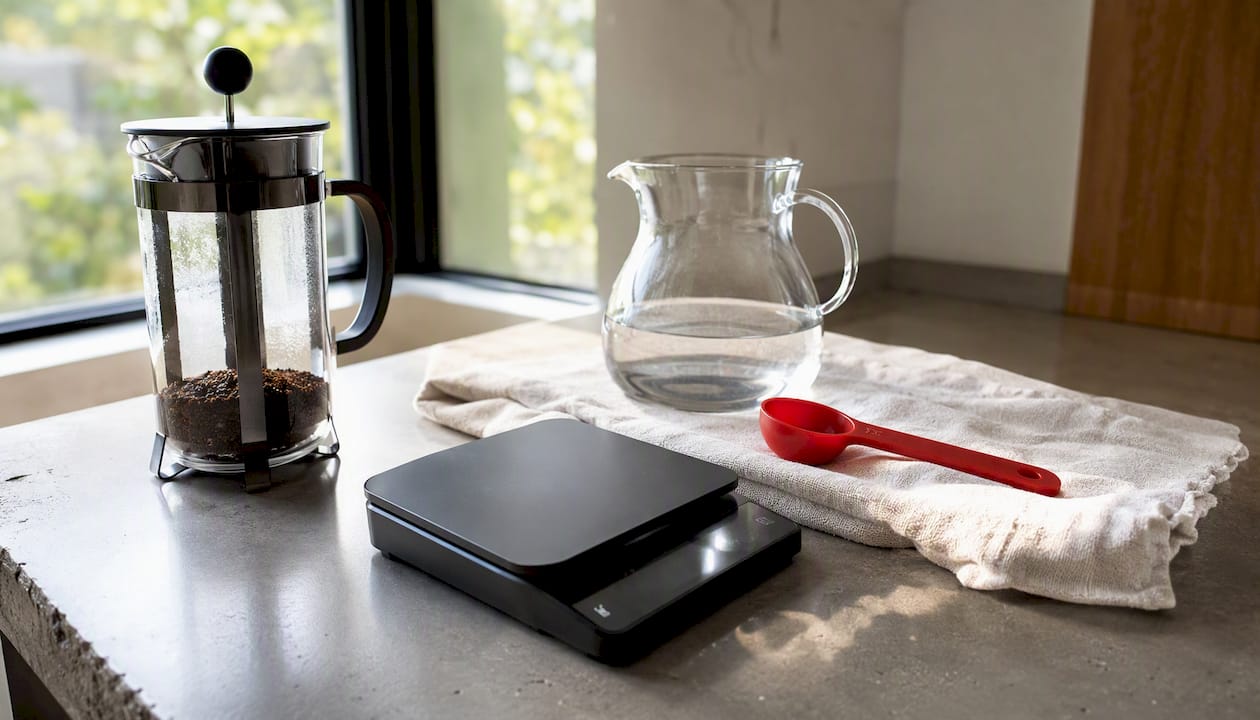
- Weigh your coffee and water. Use a kitchen scale, not a scoop. For a standard 12 oz (350 ml) press, that’s about 23 grams of coffee at a 1:15 ratio. Want a bolder cup? Drop to 1:13. Prefer something lighter? Stretch to 1:17.
- Grind just before brewing. Set your burr grinder to its coarse range and check the output against a pinch test (more on that below). Whole beans lose aromatic compounds fast once ground, so grind in the same five minutes you plan to brew.
- Bloom for 30 seconds. Pour just enough hot water to saturate the grounds, wait 30 seconds for the coffee to degas, then top off with the rest of your water. Put the lid on with the plunger pulled up.
- Steep for 4 minutes. Set a timer. Don’t stir unless your recipe specifically calls for it. At the 4-minute mark, plunge slowly and steadily. A recipe of 30 grams of coffee to 450 ml of water at about 93°C with a 4-minute steep is a dependable starting formula.
- Pour immediately into your serving vessel. Don’t let coffee sit on the grounds in the press, even after plunging. Residual contact keeps extracting and turns a good cup bitter within minutes.
Water temperature matters more than most people assume. Aim for 200°F (93°C), which is roughly 30 to 45 seconds off a rolling boil. Water that’s too hot pulls out harsh, bitter compounds fast; water that’s too cool leaves flavor locked in the grounds.
Here’s how the math shakes out for common press sizes:
- 8 oz press: ~15 g coffee at 1:15, or ~13 g at 1:17
- 12 oz press: ~23 g coffee at 1:15, or ~20 g at 1:17
- 17 oz press: ~32 g coffee at 1:15, or ~28 g at 1:17
- 34 oz press: ~64 g coffee at 1:15, or ~57 g at 1:17
What Does Coarse Grind Actually Look Like?
“Coarse” is a vague word until you’ve held it in your hand. The clearest comparison: think coarse sea salt or steel-cut oats, not table salt and definitely not flour. If your grounds look like rough breadcrumbs, you’re in the right neighborhood. If they look like beach sand or powdered sugar, you’re headed for a muddy, over-extracted cup.
Measured on particle analyzers, that visual sweet spot lands somewhere around 690 to 1,300 microns, with fines under roughly 600 microns being the real troublemakers. Those tiny particles slip past the mesh filter and sit at the bottom of your cup as sludge. Other grind charts place the ideal French press range closer to 800 to 1,100 microns, which tells you the exact number matters less than staying consistently coarse and avoiding a wide spread of particle sizes.
You don’t need a microscope to check your work. Two simple tests do the job:
- The pinch test: rub a small amount of grounds between your thumb and forefinger. It should feel gritty and distinct, like rubbing salt, never silky or powdery.
- The rub test: press grounds against a white plate or napkin. If a fine, sandy residue smears across the surface, your grinder is producing too many fines.
Pro Tip: Grab a fine mesh kitchen sieve and shake a tablespoon of your ground coffee through it for ten seconds. If a noticeable dust cloud collects in a bowl underneath, your grinder is running too fine or your burrs need cleaning.
Why Does My French Press Coffee Taste Bitter or Weak?
Taste is the final verification step, and it tells you exactly what to fix. Extraction problems fall into three basic camps, each with its own fingerprint.
Bitter, muddy, or harsh usually means over-extraction: the grind is too fine, the water was too hot, or the steep ran long. Sour, weak, or watery points to under-extraction: the grind is too coarse, the water wasn’t hot enough, or you pulled the plunger too soon. Gritty texture or visible sludge signals too many fines making it through the mesh, often from a blade grinder or worn burrs.
| Symptom | Likely Cause | First Adjustment | Follow-Up Check |
|---|---|---|---|
| Bitter, harsh finish | Grind too fine or steep too long | Go one step coarser | Retaste at same 4-minute steep |
| Sour or thin flavor | Grind too coarse or steep too short | Go one step finer, or extend steep by 30 seconds | Retaste; adjust only one variable |
| Muddy, sludgy cup | Too many fines passing through mesh | Check grinder for fines with a rub test | Clean burrs, recheck output |
| Flat, dull taste | Water temperature too low | Raise brew water closer to 200°F | Retaste after temperature fix |
Change one variable at a time. If you adjust grind, ratio, and steep time all at once, you’ll have no idea which fix actually solved the problem. A reliable process looks like this:
- Taste the cup and identify the dominant flaw (bitter, sour, or gritty).
- Make one adjustment, typically a single grinder click or a visibly coarser or finer setting.
- Brew the exact same recipe again and taste side by side if possible.
- If the flaw is gone but the cup still isn’t right, adjust steep time next rather than grind again.
- Log what worked so you’re not restarting from zero every morning.
Extraction and tasting protocols built around this kind of sensory feedback loop, like the ones outlined by Barista Hustle, treat taste as the real diagnostic tool, with mechanical checks like grind and ratio as the levers you pull in response.
Which Grinder Setting Works Best for French Press?
Burr grinders are the only real option here. They crush beans between two abrasive surfaces to produce a consistent particle size, which is exactly what a French press needs. Blade grinders chop coffee unevenly, leaving you with a mix of boulders and dust in the same batch, guaranteeing both under-extraction and over-extraction in the same cup.
Setting ranges vary wildly between grinder models, so there’s no universal “set it to 22” answer. That said, here’s what coarse typically looks like across common home grinder types:
- Manual hand grinders: often near the top 4 to 6 clicks of the coarse end of the dial
- Electric flat burr grinders: usually in the top quarter of the available range, sometimes labeled with a French press icon
- Conical burr grinders: typically 2 to 3 steps back from the coarsest setting, since the coarsest setting on some models is meant for cold brew
Always treat your grinder’s manual as a starting point, not gospel, and verify with a pinch test every time you switch beans or roast levels, since oil content and density change how a bean fractures.
Pro Tip: Weigh your ground output against your input. If you grind 25 grams of beans and get 24.7 grams of usable grounds after sifting out fines, your grinder is performing well. A big gap usually means excessive fines or static clinging to the chamber.
Routine maintenance keeps settings honest over time. Burrs accumulate coffee oils and micro-fines that shift your dial’s real output even when the number stays the same, so a regular cleaning schedule matters more than most home brewers realize.
Why Does French Press Coffee Have Sediment at the Bottom?
Sediment comes down to a mismatch between mesh size and particle size. A French press filter is a metal mesh, not paper, and it’s built to catch coarse particles while letting some fine ones through by design. Fines under roughly 600 microns slip past it, dissolve differently than larger particles, and raise your total dissolved solids unevenly, which shows up as both extra body and unwanted grit.
You have three practical levers, ranked by effort and effectiveness:
- Grind coarser first. This eliminates the fines at the source rather than filtering them out after the fact, and it’s the highest-leverage fix available.
- Decant immediately after plunging. Don’t leave brewed coffee sitting in the press. Pour it all into a carafe or your cup right away so grounds stop steeping and settling continues in a separate vessel.
- Use a secondary pour-through filter. A paper filter or fine mesh strainer between the press and your cup catches fines a metal mesh misses, at the cost of stripping out some of the oils that give French press its signature body.
There’s a real tradeoff buried in that third option. Paper filtering gets you a cleaner, almost drip-coffee-like clarity, but it also removes some of the mouthfeel that makes people choose immersion brewing in the first place. If body is the whole point for you, fix it at the grind, not with a filter.
Quick Reference: Coffee-to-Water Ratios by Press Size
Save this for mornings when you don’t want to do math before coffee.
For a 350 ml press, that’s 23 grams of coffee against 350 grams of water on a scale, using a coarse grind and a 4-minute steep, roughly the same math backing the standard French press ratio recommended across most brewing guides. Measure by weight every time, not scoops or tablespoons. Bean density varies enough between roasts that a “scoop” of a dark French roast and a scoop of a light Ethiopian can differ by several grams, and that difference throws off your whole ratio before you’ve even started brewing.
Common Grind Size Myths That Ruin French Press Coffee
A few persistent myths keep home brewers stuck with mediocre cups for years.
Myth: Finer grind means stronger coffee. Fact: in immersion brewing, finer grounds mean more surface area contacting water for the same 4 minutes, which usually means over-extraction and bitterness, not strength. If you want a stronger cup, add more coffee at the same coarse grind, don’t grind finer.
Myth: Adding extra coffee fixes a weak cup. Fact: if your cup tastes sour or thin, the problem is usually extraction, not quantity. Grind slightly finer or extend the steep before reaching for more beans.
Myth: Any grinder will do in a pinch. Fact: blade grinders produce such an inconsistent mix of particle sizes that you can’t reliably troubleshoot anything. You’re fighting boulders and dust in the same brew.
Mistake: Leaving coffee on the grounds after plunging. Even after the plunger’s down, coffee in contact with the mesh keeps extracting. Pour it out immediately.
Mistake: Measuring by volume instead of weight. A scoop varies too much between roast levels and bean densities to be reliable. A $15 kitchen scale solves this permanently.
Mistake: Ignoring fines. Treating every muddy cup as a “French press thing” instead of a fixable grinder problem means living with sediment forever when a coarser grind setting would clear it up.
Why Does Grind Size Change How French Press Coffee Tastes?
Grind size controls extraction because it controls surface area. Smaller particles expose more coffee surface to water in the same amount of time, so they release compounds faster, including the bitter ones that come out last in the extraction process. Coarser particles expose less surface area, so they need the full 4-minute steep to pull enough flavor without also pulling the harsh stuff.
Here’s a concrete example. If you accidentally use a medium grind (the kind meant for drip machines) at a full 4-minute French press steep, you’ll get a flood of fines and dramatically more surface area than the immersion time is designed for. The result is a cup that’s simultaneously muddy in texture and harsh in flavor, essentially over-extracted and sediment-heavy at once. The fix in the moment: cut the steep time down to 2.5 or 3 minutes to limit contact time, then switch to a properly coarse grind for your next brew. Charts placing French press extraction in the 700 to 1,100 micron range exist precisely because that band gives water enough time to extract balanced flavor without drowning the cup in fines. For a deeper look at how extraction chemistry plays out across brew methods, Tri Crow Coffee’s guide to coffee extraction breaks down the mechanics further.
A Brewer’s Perspective From Tri Crow Coffee
We default to a slightly coarser grind than most guides recommend, closer to steel-cut oats than the finer end of “coarse sea salt,” and we start every French press at 1:15 before adjusting for roast. Our reasoning is simple: it’s far easier to fix an under-extracted cup by adding 30 seconds to the steep than it is to fix a muddy, over-extracted one after the fact. Starting coarse gives you room to correct forward instead of scrambling backward.
That philosophy comes out of small-batch roasting, where we control variables tightly enough to know exactly how a given roast behaves at different grind settings, something we build into every batch alongside the ritual-focused approach described on our brand page. If you’re building your own French press routine, a bold roast profile tends to be more forgiving of small grind inconsistencies than a delicate light roast, since the deeper roasting process already breaks down some cell structure and evens out extraction. For a home brewer still dialing in equipment and technique, that forgiveness is worth something.
Try Tri Crow Coffee’s Coarse-Ground Blends for Your French Press
Everything above works with any decent burr grinder and any bag of beans. But if you’d rather skip a round of trial-and-error grinding, Tri Crow Coffee offers whole-bean and coarse-ground options roasted in small batches specifically suited to immersion brewing.
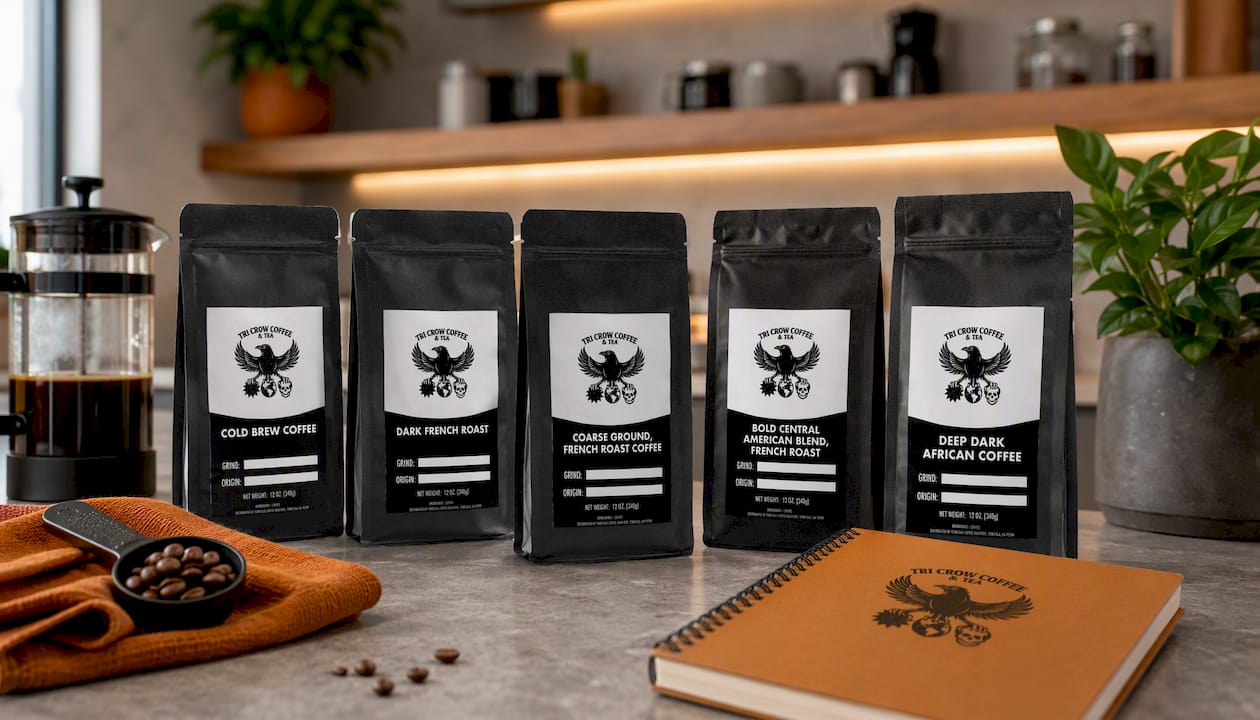
Our cold brew coffee in dark French roast, coarse ground is pre-ground to the exact texture this guide describes, which removes the grinder-calibration step entirely if you’re still working out your equipment. If you want something bolder for a full-bodied morning cup, the Central American French roast blend delivers the deep, low-acid profile that pairs naturally with a coarse grind and a 4-minute steep. And for readers chasing a more bittersweet, intensely dark profile, our African French roast holds up particularly well at the 1:13 ratio for a stronger cup.
Start with a single bag or a sample pack, dial in the ratio that suits your taste, and treat the first few brews as an experiment rather than a test you need to pass.
Sources
- French Press Ratio: How Much Coffee Per Cup (and Why It Matters) | Barista At Home
- French Press Grind Guide: Eliminate Muddy Coffee | First French Press
- French Press Brew Guide: Ratio, Grind, Temp & Steps (2026)
- Coffee Grind Size Chart: Expert Guide | The Coffee Locator
- Grind Size by Brew Method Guide: Espresso, Filter, Immersion Full Chart | ExpertCafe
FAQ
What is the best grind size for a French press?
A coarse grind resembling sea salt or steel-cut oats works best, generally landing in the 700 to 1,100 micron range measured by particle analyzers.
What is the 15-15-15 rule for coffee?
There’s no single standardized “15-15-15” framework in French press brewing guides; the closest widely used version is the 1:15 ratio paired with a 4-minute steep, which most brewers round toward for simplicity.
What is the recommended coffee-to-water ratio for a French press?
The standard baseline is 1:15 by weight, meaning 1 gram of coffee per 15 grams of water, adjustable to 1:13 for a stronger cup or 1:17 for a milder one.
How much coffee should I use for a 4-cup French press?
A typical 4-cup French press holds about 350 ml (12 oz) of water, which calls for roughly 23 grams of coffee at the standard 1:15 ratio.
Why does my French press coffee taste gritty?
Gritty texture usually means fines are slipping through the mesh filter; grinding coarser and using a burr grinder instead of a blade grinder fixes most cases.